When Your Child's Behavior Is Becoming Difficult to Manage
Parenting young children comes with its share of challenges. Tantrums, emotional outbursts, difficulty following directions, separation anxiety, and power struggles are common concerns as children grow and develop. However, when challenging behaviors become more frequent, intense, or difficult to manage, parents may begin wondering whether their child could benefit from additional support or therapy.
Perhaps your child has a hard time transitioning between activities, becomes extremely upset when things don't go their way, struggles with separation, or frequently refuses to follow directions. You may find yourself repeating instructions, negotiating, or feeling like everyday routines have turned into a battle.
You may have tried different parenting strategies, read books, or sought professional support, but still feel unsure about what will actually help your child.
When considering therapy, parents often assume that all child therapy looks relatively similar. However, there are different therapeutic approaches, and the way treatment is delivered can make a meaningful difference, particularly when working with young children between the ages of 2 and 7.
Two approaches you may encounter are traditional child therapy and Parent-Child Interaction Therapy (PCIT).
Both can support children's emotional and behavioral development, but they differ in their structure, focus, and the role parents play throughout treatment.
Understanding these differences can help you make a more informed decision about the type of support that may be most beneficial for your child and family.
What Is Traditional Child Therapy?
Traditional child therapy is a broad term that describes different therapeutic approaches used to help children understand their emotions, develop coping skills, address behavioral concerns, and navigate challenges in their everyday lives.
Depending on the child's age, developmental level, and presenting concerns, therapy may incorporate:
Play therapy: Using toys, games, art, and imaginative play to help children communicate experiences and express emotions.
Cognitive Behavioral Therapy (CBT): Helping children recognize connections between their thoughts, feelings, and behaviors while developing more helpful ways of responding to difficult situations.
Emotional identification: Teaching children to recognize, name, and communicate their feelings.
Coping skills: Helping children develop strategies for managing frustration, anxiety, disappointment, and other difficult emotions.
Behavioral interventions: Teaching skills and strategies to address specific behaviors and improve emotional regulation.
Traditional child therapy may involve individual sessions with the child, parent consultations, family sessions, or a combination of these approaches. The amount of parent involvement varies depending on the therapist, treatment model, child's age, and treatment goals.
At What Age Can Children Start Traditional Therapy?
Children do not have to reach a particular age before they can benefit from therapy. Young children can participate in developmentally appropriate interventions, including play-based and parent-child approaches, even during the toddler and preschool years.
However, the way therapy is delivered needs to match a child's developmental abilities.
For example, a 3-year-old may not yet have the language, attention, or abstract reasoning skills needed to participate in traditional talk therapy or independently apply coping strategies. Instead, therapy may involve play, observation, parent guidance, and activities that support emotional and behavioral development.
As children approach school age, typically around ages 6 or 7, they may become more developmentally ready to participate in structured, individual therapy sessions. At this stage, children may be better able to engage in traditional “talk therapy,” where they meet individually with a therapist to explore their thoughts and feelings, develop coping strategies, and practice new ways of responding to challenging situations.
This is not a strict age cutoff. Children's developmental abilities vary, and treatment should be selected based on the individual child rather than age alone.
Is Traditional Child Therapy Effective for Young Children?
Absolutely. Traditional child therapy can be effective for young children when the treatment approach is appropriate for their developmental level and specific needs.
For example, play-based interventions can provide opportunities for children to express themselves, work through experiences, and develop emotional awareness. Parent-child and family-based interventions can also help strengthen relationships and support changes outside the therapy setting.
However, one important consideration is that learning a skill during a therapy session does not necessarily mean a young child can independently use that skill at home, school, or during an emotionally challenging situation.
This is particularly important when working with children between the ages of 2 and 7 who are experiencing frequent behavioral difficulties or anxiety.
Why Parent Involvement Matters in Young Child Therapy
Young children are still developing the foundational skills needed to recognize emotions, communicate their needs, regulate their feelings, manage frustration, and navigate challenging situations.
Unlike older children and adolescents, young children rely heavily on caregivers to help them navigate their emotional experiences and manage everyday challenges.
Parents are also the people who spend the most time with their children. They are present during morning routines, transitions, bedtime, separation, sibling disagreements, and the many everyday situations where behavioral and emotional difficulties may arise.
This makes parents an essential part of the therapeutic process.
Children Need Opportunities to Practice Skills Outside the Therapy Room
Imagine a 4-year-old who struggles with separation anxiety.
During an individual therapy session, the child may be able to identify that they feel worried when separating from a parent. They may learn to name their feelings, practice deep breathing, or identify something that helps them feel safe.
These are valuable skills. However, what happens when the child is standing at the classroom door, crying, clinging to their parent, and refusing to separate?
At that moment, the child may have difficulty remembering or independently applying what they practiced in therapy.
This is where parent involvement becomes particularly important.
Parents can learn how to respond to their child's anxiety in ways that validate their feelings while also encouraging confidence, independence, and gradual opportunities to face fears.
The same applies to behavioral difficulties. A child may demonstrate cooperation during a therapy session but continue struggling with following directions, transitions, and limits at home.
Parents need practical strategies they can use consistently in those everyday situations.
Why Traditional Child Talk Therapy May Not Improve Behavior at Home
Some parents seek therapy hoping their child will learn to manage their emotions, reduce tantrums, follow directions, or become more comfortable with situations that trigger anxiety.
Yet, after several sessions, they may notice little change in their child's behavior outside the therapy room.
This does not necessarily mean therapy is ineffective or that the child is not making progress. There are several reasons this can happen, particularly when working with younger children.
1. Young children have limited ability to independently apply what they learn.
A young child may understand a coping strategy when calm and engaged in a session but struggle to remember or use it when overwhelmed. Skills need to be practiced repeatedly and supported by caregivers in real-life situations.
2. The underlying parent-child interaction patterns may not be addressed.
Behavior does not occur in isolation. Interactions between parents and children, including how directions are given, how limits are established, and how adults respond to challenging behavior, can influence behavioral patterns.
When therapy focuses primarily on the child without addressing these interactions, important opportunities for change may be missed.
3. Parents may not receive enough guidance on how to respond.
Parents are often given suggestions to practice at home, but knowing what to do and knowing how to implement a strategy during a difficult moment are two different things.
Without opportunities to receive individualized guidance, feedback, and practice, it can be difficult to know whether a strategy is being used effectively or how to adjust it.
4. Anxiety may unintentionally be reinforced through everyday interactions.
When a child becomes anxious, it is natural for parents to want to protect them from distress. However, repeatedly removing a child from situations that trigger anxiety, providing excessive reassurance, or accommodating every fear can sometimes unintentionally maintain the anxiety cycle.
Parents benefit from learning how to validate their child's feelings while gradually encouraging approach behaviors, confidence, and independence.
5. Progress in the therapy room may not generalize to everyday life.
A child may demonstrate new skills in a structured, supportive environment but struggle to use them during real-life challenges.
For lasting progress, children need opportunities to practice new skills with the people and in the environments where difficulties actually occur.
This is why parent involvement is particularly important in early childhood treatment. Rather than relying solely on what happens during a therapy session, treatment can equip parents with the tools and confidence to support their child's progress throughout the week.
Importantly, this does not mean that parents are responsible for their child's behavioral or emotional difficulties. It means parents can become an important part of the solution when they receive the right support.
What Is Parent-Child Interaction Therapy (PCIT)?
Parent-Child Interaction Therapy (PCIT) is an evidence-based, structured treatment approach designed primarily for young children between the ages of 2 and 7 who experience behavioral difficulties.
Unlike approaches that focus primarily on working with the child individually, PCIT involves both the parent and child participating in treatment together.
The therapist provides guidance and live coaching while parents interact with their children, helping them learn and practice specific skills in real time.
The goal is to strengthen the parent-child relationship, increase positive interactions, improve cooperation, and reduce challenging behaviors.
PCIT consists of two primary phases:
1. Child-Directed Interaction (CDI): Strengthening the Parent-Child Relationship
The first phase focuses on strengthening the parent-child relationship through positive, child-led play.
Parents learn specific skills, commonly referred to as PRIDE skills:
Praise: Providing specific, positive attention when children demonstrate desirable behaviors.
Reflection: Repeating or reflecting what children say to encourage communication.
Imitation: Following the child's lead during play.
Description: Narrating what the child is doing to demonstrate interest and attention.
Enjoyment: Communicating genuine warmth, enthusiasm, and enjoyment during interactions.
These skills help parents build positive connections with their children, increase positive attention, and create more opportunities for successful interactions.
For many families, this phase is especially meaningful because challenging behaviors can sometimes become the primary focus of parent-child interactions. CDI helps shift some of that attention toward connection, positive communication, and the behaviors parents want to encourage.
2. Parent-Directed Interaction (PDI): Building Cooperation and Managing Behavior
The second phase focuses on helping parents establish clear expectations, give effective directions, and respond consistently when children have difficulty following them.
Parents learn how to:
Give clear, age-appropriate directions.
Encourage cooperation and following directions.
Respond consistently to noncompliance.
Establish predictable boundaries and consequences.
Reduce power struggles and repeated prompting.
Rather than simply telling parents what strategies to use, the therapist provides live coaching as parents practice these skills with their children.
This allows parents to receive immediate feedback, build confidence, and make adjustments with the therapist's support.
What Makes PCIT Effective?
One of the biggest differences between PCIT and many other forms of child therapy for child behavior and anxiety is that parents are not simply given strategies to try at home. They learn, practice, and receive feedback on those strategies during treatment.
There are several reasons this approach can be particularly helpful for young children.
1. Parents learn skills they can use in everyday situations.
Because parents are actively involved, the skills learned in therapy can be incorporated into daily routines, transitions, playtime, and challenging interactions.
2. Coaching happens in real time.
Instead of waiting until the next appointment to discuss what happened at home, parents receive immediate feedback while interacting with their children.
3. Treatment focuses on both connection and behavior.
PCIT does not focus exclusively on reducing challenging behaviors. It also emphasizes strengthening positive parent-child interactions and building a nurturing relationship.
4. Treatment is individualized and progress-based.
PCIT is a structured treatment, but families do not simply move through sessions based on a predetermined number of appointments. Progression through the treatment phases is based on family readiness.
5. Children benefit from consistent support across environments.
As parents become more confident using the skills, children have more opportunities to experience consistent expectations, positive attention, and supportive responses outside the therapy room.
PCIT vs. Traditional Child Talk Therapy: 5 Key Differences
Both approaches can help children develop emotional and behavioral skills. However, there are important differences in how treatment is delivered.
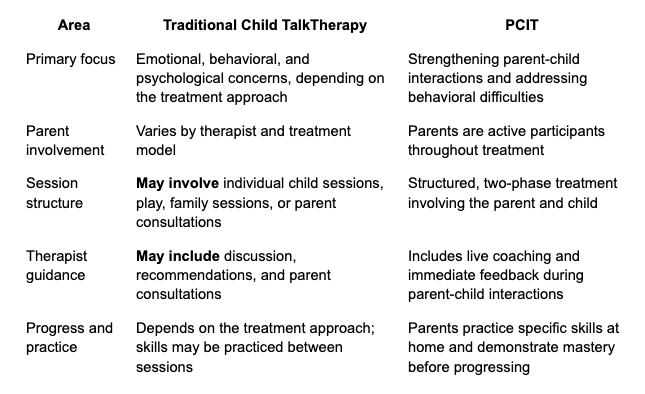
The most important distinction is not that one approach is universally better than the other. It is that each approach serves different needs.
For young children experiencing frequent behavioral difficulties, a treatment model that actively teaches and coaches parents may be particularly beneficial.
Which Children Benefit Most From PCIT?
PCIT is generally designed for children between the ages of 2 and 7 who experience frequent or intense behavioral difficulties.
It may be a good fit for children who:
Have frequent tantrums or emotional outbursts.
Struggle with following directions or accepting limits.
Demonstrate defiant or oppositional behaviors.
Engage in hitting, aggression, or other disruptive behaviors.
Have difficulty with transitions and daily routines.
Experience frequent parent-child power struggles.
Have difficulty managing frustration and disappointment.
Have ADHD-related behavioral challenges.
Need additional support strengthening their relationship with caregivers.
For children whose primary concern is anxiety, specialized anxiety-focused adaptations of PCIT may be considered when clinically appropriate. The specific treatment approach should be selected based on the child's symptoms and needs.
When Might Traditional Child Talk Therapy Be a Better Fit?
PCIT is an effective approach for many young children, but it is not the right treatment for every child or every concern.
Traditional child therapy or another specialized treatment approach may be a better fit when:
The child is older: Older children may benefit from individual therapy approaches that involve more direct discussion, reflection, and independent skill development.
The primary concern is anxiety: Older children around 7+ with anxiety may benefit from Cognitive Behavioral Therapy (CBT), exposure-based interventions, or other anxiety-specific treatments.
The child is experiencing trauma or significant life changes: Depending on the child's needs, trauma-focused or attachment-based interventions may be more appropriate.
The child needs support with emotional expression: Play therapy or other developmentally appropriate approaches may help children process experiences and communicate feelings.
The presenting concerns fall outside PCIT's primary treatment focus: Some developmental, emotional, and psychological concerns require different or additional interventions.
What About Cognitive Behavioral Therapy (CBT) for Anxious Children?Cognitive Behavioral Therapy (CBT) is one of the most well-established evidence-based approaches for treating childhood anxiety.
CBT helps children understand the relationship between their thoughts, feelings, and behaviors. They learn to recognize anxious thinking patterns, develop coping strategies, and gradually face situations they may be avoiding.
For example, a child who is afraid of making mistakes may learn to recognize unhelpful thoughts such as, "If I get something wrong, everyone will laugh at me," and practice developing more balanced ways of thinking.
CBT often incorporates gradual exposure, which helps children build confidence by facing feared situations in manageable steps rather than avoiding them.
CBT can be appropriate for some children around ages 7+, depending on their developmental readiness, language abilities, and capacity to participate in structured cognitive activities.
However, younger children may have difficulty independently understanding and applying cognitive strategies, especially when they become emotionally overwhelmed.
In these situations, parent involvement remains important. Parents can help children practice coping strategies, support gradual exposure to feared situations, and respond in ways that encourage confidence rather than avoidance.
For preschool-aged children and younger school-aged children, parent-focused interventions and developmentally adapted anxiety treatments may be more appropriate.
The goal is not to choose a treatment based on age alone, but to select an approach that matches the child's developmental abilities and the nature of their difficulties.
Does PCIT Actually Work?
Yes! PCIT is backed by decades of research and has been shown to help reduce challenging behaviors in young children while strengthening the parent-child relationship.
A research review published in Pediatrics looked at 23 studies involving 1,144 participants and found that PCIT was more effective than comparison approaches in reducing children's challenging behaviors. Parents also experienced improvements in parenting-related stress, and children showed improvements in following parental directions.
Research supports the importance of actively practicing the skills learned in PCIT rather than simply attending sessions. This is why PCIT includes hands-on coaching and opportunities for parents to practice new ways of responding to their child.
The goal isn't to be a perfect parent or to get every skill exactly right. It's to help you feel more confident in responding to your child's behaviors, reduce the frequency and intensity of challenging behaviors, and build a stronger foundation for your family to manage challenges together.
Research has also explored the use of PCIT adaptations for young children experiencing anxiety. These approaches incorporate strategies that help parents encourage children to gradually approach feared situations, build confidence, and reduce avoidance.
PCIT is not a quick fix, and every family's experience and progress will look different. Several factors can influence how quickly a family sees progress, including:
Family readiness for change: How ready and open caregivers feel to try new approaches and make changes to familiar parenting patterns.
Parent commitment and daily practice: Consistently practicing the skills at home is an important part of helping children develop new behaviors. PCIT recommends approximately five minutes of daily practice.
Severity of behavioral concerns: The frequency, intensity, and complexity of a child's challenging behaviors can influence the time and support needed.
Child's temperament: Every child responds differently to new expectations and parenting approaches. Some children may need more time and support to adjust.
Family circumstances and additional barriers: Stress, family transitions, competing responsibilities, and other challenges can sometimes make it harder to attend sessions or practice skills consistently.
PCIT is a structured, hands-on approach that gives parents ongoing guidance and opportunities to practice new skills in everyday situations. The goal is to help parents feel more confident in responding to their child, reduce challenging behaviors, and help the family feel better equipped to manage challenges together.
Finding PCIT Therapy in Florida
If your child is between the ages of 2 and 7 and you are experiencing ongoing challenges with tantrums, defiance, aggression, emotional regulation, parent-child interactions, or anxiety, PCIT may be worth exploring.
When looking for a PCIT therapist, consider asking:
Does the therapist have a certification in PCIT?
Do they provide live coaching during parent-child interactions?
How will progress be measured?
What level of parent participation is expected?
Is the treatment tailored to my child's specific needs?
Working with a therapist who is certified in PCIT can help ensure that treatment follows the model's core principles while remaining responsive to your family's needs.
At Empowering Families Counseling, I work with parents and young children to address challenging behaviors, strengthen parent-child relationships, and develop practical strategies that families can use beyond the therapy room.
As a Florida Licensed Mental Health Counselor and Certified PCIT Therapist and Trainer, I provide specialized support to families navigating behavioral difficulties and childhood anxiety.
My approach recognizes that parents are an essential part of their child's emotional and behavioral development. Rather than placing the responsibility entirely on the child to change, treatment focuses on giving parents the tools, guidance, and confidence to support meaningful progress.
If you are wondering whether PCIT is the right fit for your child, I invite you to schedule a complimentary 15-minute consultation to discuss your concerns and explore whether this approach may be helpful for your family.
Frequently Asked Questions: PCIT vs. Traditional Talk Therapy for Children
-
Neither approach is universally better; the most appropriate option depends on the child's age, needs, and treatment goals. PCIT is an evidence-based treatment designed primarily for young children ages 2–7 who are experiencing behavioral difficulties. It emphasizes active parent involvement, skill-building, and live coaching to help parents strengthen their interactions with their child and address challenging behaviors.
Traditional talk therapy may be a better fit for older children and adolescents, as well as children whose primary concerns involve emotional, social, developmental, or psychological challenges that may benefit from individual therapeutic support.
The goal is to identify the approach that best meets the child's developmental level and the family's needs.
-
PCIT is typically designed for children between the ages of 2 and 7. It is particularly helpful during early childhood, when parents play an important role in supporting emotional regulation, communication, and behavior.
-
Yes. Parents or primary caregivers are active participants throughout PCIT. Rather than attending occasional parent consultations, caregivers learn and practice specific skills with their children while receiving guidance from the therapist.
-
Play therapy generally uses play as a primary means of helping children express themselves, explore emotions, and work through experiences. PCIT also incorporates play, particularly during the Child-Directed Interaction phase, but its primary focus is strengthening parent-child interactions and improving behavioral outcomes through structured parent training and live coaching.
-
Standard PCIT primarily addresses disruptive behaviors and parent-child interactions. However, specialized adaptations of PCIT have been developed for young children experiencing anxiety, including approaches that incorporate gradual exposure and parent coaching. A therapist can help determine whether an anxiety-focused intervention is appropriate.
-
It depends on the child's age, developmental level, cognitive abilities, and the nature of their anxiety symptoms. CBT is a well-established treatment for childhood anxiety and is generally most appropriate for children who are developmentally able to understand and apply concepts such as identifying thoughts, recognizing how thoughts influence feelings and behaviors, and learning strategies to manage anxiety. This is often more feasible for older children, although some children around ages 6–7 may be ready depending on their individual abilities.
Younger children, or those who may not yet have the developmental or cognitive skills needed for traditional CBT, may benefit more from parent-focused or developmentally adapted approaches that teach caregivers how to support their child in managing anxiety. Parent involvement can be valuable in either approach, although the level and type of involvement may vary.
-
PCIT is a progress-based treatment, meaning the length of therapy depends on how quickly caregivers demonstrate confidence in the skills being taught. Many families complete treatment over approximately 12–20 sessions, although the number of sessions varies.
-
This is one reason parent involvement and practice outside the therapy room are so important. Children may respond differently depending on the environment, expectations, and people involved. PCIT helps parents practice strategies in real time so they can apply those skills during everyday interactions at home.
-
Absolutely. Parent involvement can be particularly beneficial for toddlers and preschool-aged children who are still developing the ability to communicate emotions, regulate their behavior, and independently use coping strategies. Treatment approaches such as PCIT are specifically designed to involve caregivers in the therapeutic process.
-
When looking for PCIT, it's important to find a therapist who is certified in PCIT and provides its core components, including parent-child sessions, live coaching, and ongoing progress monitoring.
If you're interested in learning more about PCIT or exploring whether it may be a good fit for your family, I invite you to contact me to discuss your child's needs and treatment options.